





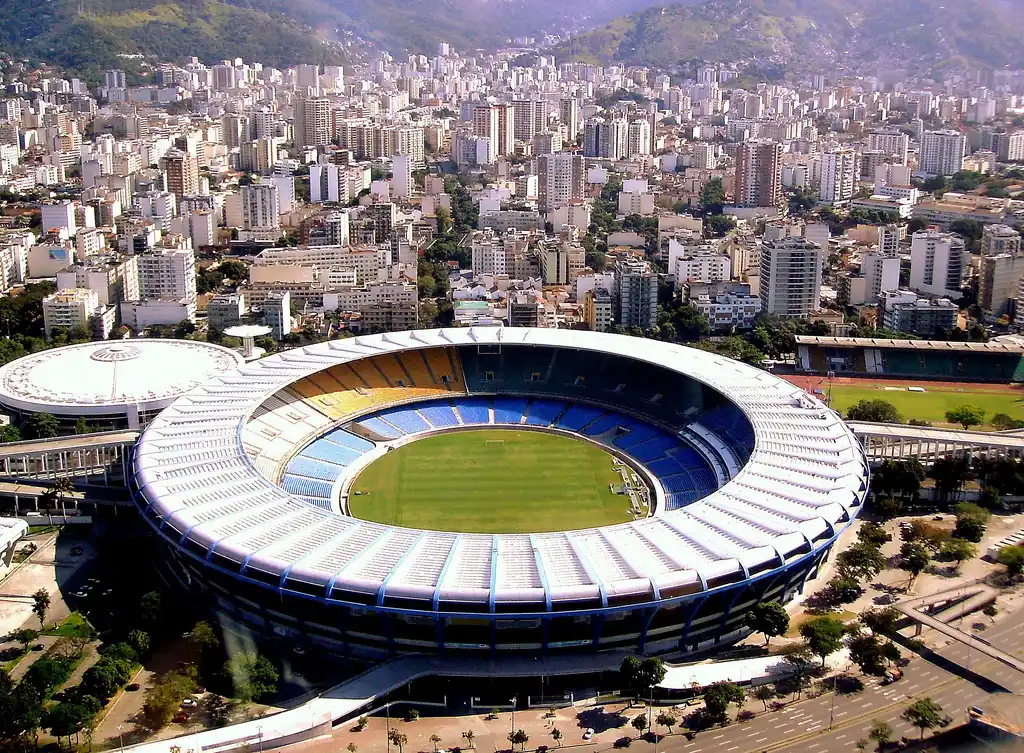
The largest stadiums in the world have long ceased to be merely a “match venue.” For fans, they become points of reference – a map of memory, a space of rituals, and a public language of identity. Maracanã, Old Trafford, Camp Nou, Azteca, Wembley, Bernabéu, or San Siro share one thing: each of these venues is a story about the society that built it, and about the football that gave it meaning.
Why do stadiums become icons?
A stadium’s iconic status does not come only from its capacity or the number of trophies won by its host. Most often, it is determined by the “interweaving” of three elements:
- threshold moments (World Cup finals, historic defeats, symbolic matches),
- architecture and urban planning (a stadium as a city’s sign, sometimes as a manifesto of an era),
- social significance (a stadium as a communal “forum,” a space of memory, sometimes of political resistance).
That is why Maracanã can be both a sports arena and a national trauma, Camp Nou – a stadium and a manifestation of Catalan identity, and Wembley – the myth of “English football” anchored in the country’s history.
Maracanã – a Brazilian national temple and a place of memory
Maracanã in Rio de Janeiro was born of ambition: Brazil wanted to show the world that it could host the World Cup and that its football deserved the biggest stage. The opening of the stadium in 1950 for the FIFA World Cup was not only a sporting event, but also a civilizational one – the venue became a symbol of modernity and a scale previously unseen in football. Its characteristic, “bowl-like” form and former capacity reaching nearly 200,000 spectators built the legend of the greatest football arena on the globe.
“Maracanazo” – a defeat that ceased to be a result
The 1950 World Cup final (Brazil – Uruguay 1:2) functions in Brazil like a founding myth… only a negative one. “Maracanazo” is not a story about a lost match – it is a narrative of disappointed expectations, of national pride put to the test, and of how sport can enter collective memory with the status of a historical event. From that moment, Maracanã became a special place: a fan enters not only a stadium, but a space of memory.
A symbol of Rio, a symbol of community
In the following decades the stadium also took on an urban dimension. Maracanã began to function like Rio’s “public living room”: a place of meetings, celebrations, sporting mourning, great triumphs. In this view, the stadium becomes a tool of integration – it builds relationships, rituals, a language of community. That is why in the Brazilian imagination Maracanã is sometimes placed alongside the most recognizable symbols of the city.
Old Trafford – the “Theatre of Dreams” as a museum of Manchester United’s identity
Old Trafford is a classic example of a stadium that has become a brand in its own right. The home of Manchester United functions like a multi-level story: about industrial England, about the development of football as mass entertainment, about tragedy and the club’s rebirth, and about the globalization of sport.
Architecture from an era that was creating modern football
The stadium opened on 19 February 1910, and its design was created in the studio of Archibald Leitch – an architect who left his mark on British stadiums of the early 20th century. From the very beginning, Old Trafford was meant to be a venue “worthy of its ambitions”: spacious, functional, commanding respect. Over time, the stadium became the stage for the club’s greatest moments, but also a place that survived war, social change, and the modernization of football.
“Theatre of Dreams” and the cult of individuals
The term “Theatre of Dreams” did not come from marketing – it stems from the experience of fans, for whom a visit to Old Trafford is an entry into the myth of Manchester United. The symbolism here is literally “built into” the space: the statues of Sir Matt Busby and Sir Alex Ferguson, the commemoration of the “United Trinity” (Best, Law, Charlton) – these are elements that cast the stadium in the role of a museum of emotions. Old Trafford is not neutral: it tells you whom and what you support.
The largest club stadium in England as a sign of status
A capacity of more than 74,000 seats makes Old Trafford the largest club stadium in England. This, too, is part of the symbolism: the stadium – like the club – is meant to be “larger than life,” prepared for a mass, global audience. In practice, Old Trafford has become a place of pilgrimage: fans from all over the world treat it as a must-see point, even when they are not United supporters.
Camp Nou – Catalan identity that survived thanks to football
Camp Nou is one of the strongest examples of how a stadium can be a cultural institution and a tool of social memory. Opened in 1957, it became the home of FC Barcelona, but it quickly grew into a space where Catalan identity could breathe – especially during periods of political pressure.
The stadium as a safer space in the Franco era
During the dictatorship of Francisco Franco, the Catalan language and symbols of regional autonomy were suppressed in public life. Camp Nou offered a certain margin of freedom: the stadium gathered masses of people, and massiveness in itself made full control more difficult. Attending a Barcelona match could then be something more than supporting the team – it was a silent declaration of belonging, a gesture of cultural endurance.
“Més que un club” as real content, not a slogan
The motto “Més que un club” at Camp Nou is not an ornament. It means that Barcelona (and its stadium) function as a space of values: democracy, culture, memory, and community. Also symbolic is the ritual referring to the year 1714 – in the 17th minute and 14th second of many matches, coordinated chants and gestures appear that refer to the fall of Barcelona during the War of the Spanish Succession. This is an example of how history permeates a sporting spectacle in a planned way that is clear to the community.
Estadio Azteca – the only such stadium in the history of World Cups
Azteca in Mexico is a stadium that can be called an “archive of football legends.” With a capacity of about 87,500 seats, it is one of the largest venues in the world, but what makes it unique above all is the fact that it hosted two FIFA World Cup finals – in 1970 and 1986.
Two eras, two football gods
In 1970, Azteca was the place where Pelé closed his myth, and Brazil won its third championship title. In 1986, the stadium became the backdrop for Maradona’s story: the “Hand of God” and the “Goal of the Century” against England are moments that went beyond sport and entered mass culture. Few places in the world have such a concentration of “scenes” that even someone who does not watch football regularly knows.
National pride and local everyday life
Azteca is also a symbol of Mexican organizational and football pride. It is an arena for great matches of the Mexico national team, but also a space for derbies and domestic league rituals. The stadium lives on two levels: global (the myth of the World Cups) and local (the everyday life of Mexican football). This duality builds its stature.
Wembley – the myth of England told through architecture
Wembley in England is something more than a national stadium: it is a point where the history of football connects with a narrative about the state, empire, mass culture, and the need for grand ceremonies. The old Wembley (with the Twin Towers) was an icon as early as 1923, and the new structure with its characteristic arch took over the role of a symbol in the 21st century.
The 1966 World Cup as the foundation of the legend
England’s victory at the 1966 World Cup functions at Wembley like a “historical seal.” This event is constantly present in fan mythology, also in chants and narratives that connect sport with the country’s history. Wembley, as the site of the final, becomes a space of memory, not just an archive of results.
From an imperial past to a modern symbol
Analyses of Wembley also include the theme of a “buried” imperial past – the old stadium was linked to the era of great exhibitions and narratives about Great Britain’s global role. The new Wembley, with an arch instead of towers, has a more contemporary dimension: it is a symbol of modernization and a desire to preserve continuity without literally clinging to forms of the past.
Santiago Bernabéu – a stadium that embodies the “Real Madrid” project
Bernabéu in Madrid is an example of a stadium that became part of the club’s strategic identity. Real Madrid does not function solely as a team – it is a global sports-business and cultural project. The stadium is its “main stage.”
Bernabéu – the man who changed European football
The name Santiago Bernabéu is no coincidence. As Real’s president for more than three decades, he co-created the club’s power and co-shaped European club competition. The thread of outlining the idea of a tournament for Europe’s best clubs (the later Champions League) builds the image of Bernabéu as a visionary, and the stadium as a material sign of that vision.
Modernization as a manifesto of contemporaneity
After the renovation, the venue became an architectural manifesto: modernity is not meant to “cover up” history here, but to reinforce it. Bernabéu thus symbolizes two worlds at once: the tradition of the most decorated club and the ambition to be a leader in the next era of football.
San Siro (Giuseppe Meazza) – the shared home of two rivals and an icon of Milan
San Siro is a stadium that functions like a metaphor for Milan: a city of elegance and industry, style and austerity. Its monumental mass, external ramps, and towers give it an almost industrial character – recognizable at first glance.
A dual identity – AC Milan and Inter under one roof
What is most unique about San Siro is that it is a shared arena for two clubs: AC Milan and Inter. This is a rare case at this level of rivalry and at the same time a source of exceptional symbolism. The stadium is sometimes “switched” depending on the host, but in terms of emotions it remains one place – shared and divided at the same time.
The derby as the city’s theatre
The Milan derby at San Siro is almost theatrical in nature: one shared space, two worlds, two languages of support. It is an experience that for many fans is as important as European finals. San Siro is therefore not only a stadium – it is the set design for Milanese rivalry, embedded in the fabric of the city.
What connects these stadiums?
Although each stadium is different, a few common mechanisms can be observed:
- Maracanã – a symbol of the nation and memory (the trauma of “Maracanazo” + a city icon of Rio).
- Old Trafford – the stadium as the club’s museum and a global pilgrimage for fans.
- Camp Nou – the stadium as a space of identity and political “endurance.”
- Azteca – the stadium as an archive of legends (Pelé, Maradona) and national pride.
- Wembley – the stadium-state: ceremony, history, the myth of 1966.
- Bernabéu – the stadium as a manifesto of power and modernity of Real’s project.
- San Siro – the stadium as a metaphor for the city and the conflict of two identities.
Summary
The iconic stadiums of the world are not great because they have great stands. They are great because they carry meanings: collective memory, local pride, political tensions, the mythology of sporting heroes, and rituals that create community. Maracanã and Azteca remind us how football can become a national experience. Old Trafford and Bernabéu show how a stadium builds a club’s legend and its global status. Camp Nou and Wembley prove that a sporting space can also be a stage of history, and San Siro – that sometimes the most interesting symbolism is born from division: one city, one stadium, two hostile colors.